Command
The Politics of Military Operations from Korea to Ukraine
At a glance
- In a line
- A brilliant, measured study of how military and political leaders share command since Korea. A must-read.
- Read it if
- you serve, or work with those who do.
Read next
It is difficult to review a book when one is in awe of its author. Command: The Politics of Military Operations from Korea to Ukraine is yet another masterful work that stamps Freedman’s credentials as a doyen of military history.
Freedman begins by informing that “the word ‘command’ comes from the Latin mandare, meaning to commit or entrust, from which we also get ‘mandate’.”1 Freedman’s book examines Samuel Huntington’s notions of subjective and objective control of the military with examples of politico-military leadership during the various conflicts beginning from the Korean War and terminating in the Russia- Ukraine war.2 Freedman is convinced that the evolution of modern warfare has steadily chipped away at the notion of objective control of the military. His examination of the conflicts is centered on the strategic level of decision-making.3 He teases out instances when the politico-military leadership has worked and others when it has not. His bouquet of cases includes Korea, the Cuban missile crisis, Israel’s wars, the India–Pak war of 1971, Vietnam, Falklands, Saddam’s wars, Chechnya, Congo, Guevara, Kosovo, Afghanistan, and the ongoing Russia- Ukraine war. The scope and scale of the examination are breathtaking. The book is structured
1 Lawrence Freedman, Command: The Poli/cs of Military Opera/ons from Korea to Ukraine (New York, NY: Oxford University Press, 2022), 1. 2 Samuel P. HunFngton, The Soldier and the State: The Theory and Poli/cs of Civil-Military Rela/ons, 19. print (Cambridge, Mass: Belknap Press, 2002), 83–84. “SubjecFve civilian control achieves its end by civilianizing the military, making them the mirror of the state. ObjecFve civilian control achieves its end by militarizing the military, making them the tool of the state”. 3 Freedman, Command, 6.
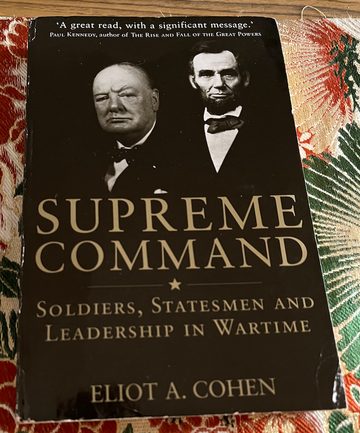
much like Eliott Cohen’s Supreme Command with the central scrutiny of synergy in thought and action of the politico-military leadership.4 In his examination of military leadership, he draws on the types of leaders enunciated by John Keegan in his book, The Mask of Command, that leaders could be heroic, anti-heroic, and false-heroic. Keegan opined that in the nuclear age, leaders who are anti-heroic are more appropriate for leadership positions, as restraint and deliberation are essential to managing conflict.5
A consistent thread running through the book is that military and political leaders operate in different ecosystems, and it’s rare to find leaders who can appreciate both. He cites Gen Marshall as someone who balanced military and political imperatives most admirably.6 Freedman informs that the practice of command has been altered significantly by the changing nature of the war. He asserts that the pace and the flow of information have made command more collaborative. In consonance, the staff supporting the commander has grown exponentially, and yet the staff struggles to provide timely and reasonably comprehensive assessments. Furthermore, while the political imperatives of a battle often favour restraint and limitation; the pace of tactical action may require delegation. Militaries the world over are struggling with this predicament.
He goes on to describe a system of Mission Command to facilitate delegation; which contrary to misperceptions of complete control involves constant communication along the chain of command for informed tactical decisions. Pontificating on the increasing requirement for delegated decision-making, Freedman argues that the severest challenge lies when the operations require decentralised forms of command however the forces are suited to the centralised form, much like the Russian command structure during the battle for Chornobayivka near Kherson airport. However, it is also worth recognising that speed of communication and its reliability makes it easier for political leaders to be involved with the fight at the tactical level, often much to the detriment of the fighting forces.
Freedman provides wise counsel on the so-called AI Commander, arguing that AI can at best be a tool to empower the commander. Dispelling the fog of war irrespective of technological advancements shall remain an illusion. AI is incapable
4 Eliot Cohen, Supreme and (London: Simon Schuster 2002) 5 John Keegan, The Mask of Command (New York, NY: Penguin, 1988). 6 Freedman, Command, 4.
of making decisions like a human, displaying raw courage, bonding, and willing the team onward and capable of thinking as new scenarios unfold. “Unlike a human commander, an AI commander may fail to attach significance to a few odd points in the incoming data that would attract human curiosity. Instead, anomalous data may lead to perverse decisions. The complexity and confusion of future battlefields as targets disperse and deceive, could leave an AI commander as baffled as a human commander, but without the ability to reappraise the situation or the restraint to hold back.”7
Freedman presents discussions on military leaders who have wilfully disobeyed their political leaders. On the dismissal of MacArthur during the Korean War, Freedman argues that MacArthur set a dangerous precedent when he positioned himself as the protector of constitutional ideas arguing that the political leadership had surrendered the ideals of the constitution. Freedman goes on to chronicle the wilful insubordination of Ariel Sharon during the wars of Israel. Sharon rationalised his disobedience by arguing that he disobeyed for the greater good of his men and the operational cause, however, the “real explanation was that he was no longer trusted by his senior commanders, so they sent him orders to control him, which he found unfair and unwise, and so tried to evade, adding to the distrust.” He presents persuasive evidence to support the assertion that dictators who ‘coupproof’ themselves by wielding power with extreme concertation at the top, would eventually cause fragmentation at the lower levels ultimately leading to the collapse of their kingdoms.
He cautions against military leaders exhibiting political leanings in office citing the case of the U.S. where Presidents have lost their ex-military character and bank on the military for political endorsements. While military leaders have exhibited restraint when in uniform but none thereafter. However, he urges that there must be an admissive environment for the military to freely express views and push back as required, lest they take recourse to other avenues for dissent.
Freedman concludes: “If there is a lesson from this book, it is not that civilians and military must stick to their own spheres of influence, and not interfere in the other’s, but that they must engage constantly with each other. Those issuing the orders should have the authority that brings the respect of colleagues and
7 Ibid., 506.
subordinates. Authority is something to be earned, not taken for granted and that goes for the civilians as well as the generals.”
Overall, a brilliant work, as good as any of Freedman’s. He is erudite, thoughtprovoking, and scholarly in his brilliant examination of the equilibrium of leadership between military and political leaders across many conflicts since the Korean War. The evidence presented and its marriage with the arguments are measured and convincing. His ability to carry the central argument of the challenge of command with its military and political dimensions across the book is extraordinary. A book that effortlessly slots itself into the must-read category for military men and women.
Reviewed by Himadri Bose · Mar 2024